
The Egg
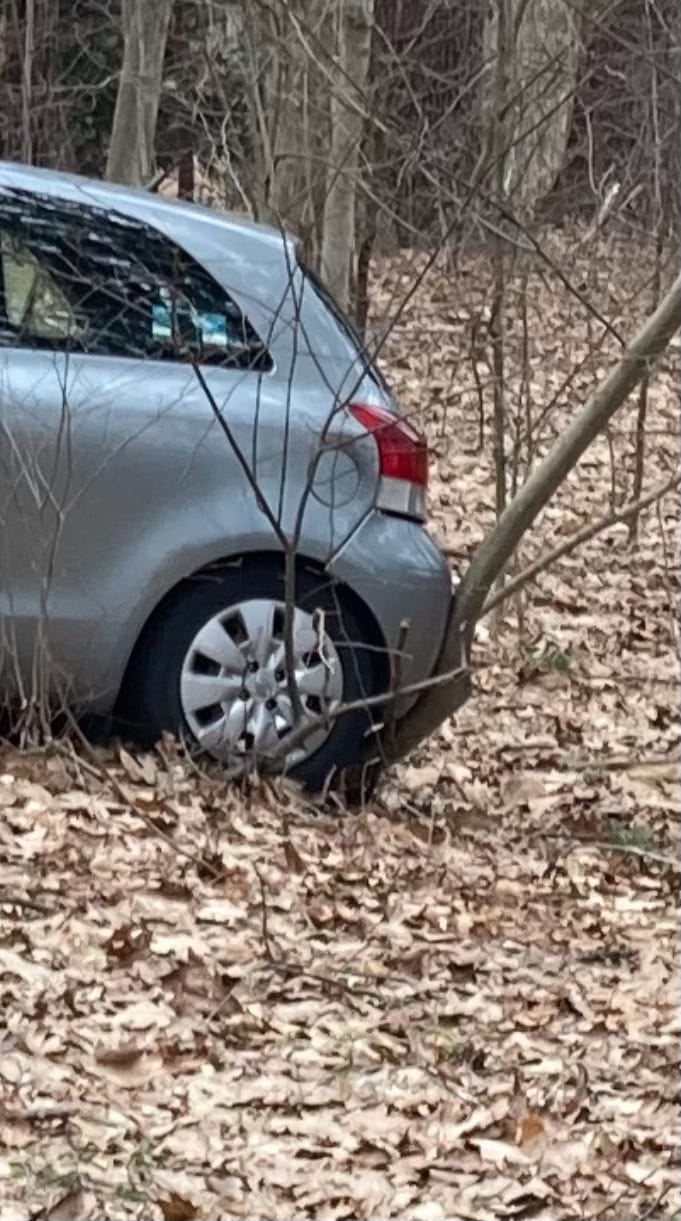
My car is a Toyota Yaris 2-door hatchback that I bought new in 2010. I would’ve preferred the 4-door for easier dog access, but there were no 4-doors in stock in my area with my preferred specifications (stick shift, no extras, no fancy stuff) and I wanted the car now (back then), so I went with the 2-door. It was never a fabulous car, as far as car fabulosity goes, but it got the job done and I was mostly happy with it. It got good mileage and the payments were manageable and the car was amusingly egg-shaped (redolent of a 1970’s AMC Pacer but with more-rounded edges [I called it “The Egg”]) and small and so easy to parallel park in tight spaces, which was very convenient for my city’s off-street residential parking situation.
When I was first looking to buy a new car way back then, 16 years ago, I searched “What are the cheapest 2010 cars on the market?” Some kind of Hyundai was at the top of the list and the Yaris was #2. I immediately crossed the top car off the list because I knew from renting cars that Hyundais were not that well-built, or at least didn’t feel to me like they were (in my experience they had a wobbly vibe), and Toyotas seemed pretty solid and dependable.
I wanted an unused one so that I wouldn’t have to worry about it, about what might be secretly wrong with it or about to go wrong. Other than my first hand-me-downed Volvo and one brief foray into vintage vehicle impracticality—my big beautiful (but temperamental) wine-colored 1969 Chevy Impala that I had for a couple of years—this was my thing, my pattern: When my existing car died, or had begun its inevitable decline toward death, long after I’d fully paid off the loan and after my having maintained the car through whatever various mechanical or other problems that would arise now and then until it was just about ready to croak, and resisting further treatment, I would arrange to charitably donate the car to NPR who would send a tow truck over to take the car away. And then I’d buy a new one.
I prefer driving a manual transmission. I found the one place in the metro Boston area (where I lived) that had a new Yaris with a stick shift and I bought it.
It served me well through various bumps and dings and things; once I was rear-ended by a SmartCar which did absolutely no damage to my rear end (the SmartCar—so tiny, so insubstantial— is probably the best car by which to be rear ended), but another time I rear-ended (lightly) a big SUV which did absolutely no damage to the SUV but cracked a portion of the semi-hard-but-not-that-hard plastic (or plastic-ish) body-frame on the front of my little Egg. Not enough for me to have it fixed, though; the car still drove fine, and at that point, with all the cracks and dents, I had started not to care anymore about the aesthetic deterioration. There comes a time, with every car, when I decide, Fuck it! And I give up trying to preserve its long-gone newness and I relax, letting muddy dogs jump in, not cleaning up drink spills, throwing trash on the floor, sticking stickers on the dashboard as well as on the outer backside, seeing scrapes and rust as just part of the body’s evolving topography; evidence of a life lived and a car driven.
Roger Rosenblatt wrote recently in the NY Times about old ladies, partly about his wife in particular (“Today, at 85, she is lovelier than ever.”). This is the last paragraph of the piece:
“Behold them, will you, as they glow in the dark. The hair gone white. The careful step. The archipelago of age spots. The blue veins in the hands. The folds in the neck. The crack in the voice. Takes your breath away.”
There is one horizontal scratch on my car that looks uncannily, suspiciously like someone keyed the car. But I am okay with this! It adds character. To be a car key-able villainess is…something. Something notable. Even if it’s not true (that I am evil).
Another time, I bang-scraped my car’s side against a floor-to-ceiling cement column as I backed in a slight turn out of a parking space in a medical office’s parking garage. Although the column was painted bright yellow, I didn’t see it; I had a blind spot (that very moment was when I first became aware that I had a blind spot). I never had the dent fixed. I did log the incident with my insurance company and had the damage assessed by a couple of mechanics but to fix the dent, they told me, would’ve cost much more than what the insurance would pay. I’d need a whole new door. But the door I had damaged—on the surface—was still working and it didn’t seem necessary to me to spend a bunch of money to essentially just make it look “better” with cosmetic surgery; make look like it had looked before (before the unfortunate incident). So I left the dent, which had a streak of yellow, and which over the years acquired some rust, too.
The only trouble, over the years, with my car—if you could call it trouble—was mostly surface-level. i.e. Not Important (to me). These were issues I didn’t need to deal with because they didn’t affect the mechanical functionality nor did I think of my car and its look as some kind of representation of my personal worth or identity (unless it was to show off how unpretentious I was); it was just a means to transport me privately and independently to and from places. The car ran fine and got me where I needed to go. It was a surprisingly good car!
It was aging, visibly, but you can’t stop the aging process, in cars as in humans. You have to accept that it is happening, that it is going to happen. Dents, wrinkles, rust, sagging skin, wobbly, cracking knees, leaky tires, sores, clogged transmission systems. You can’t stop time!
When I moved out of the city to western Massachusetts a few years ago, my property did not have a garage. My car sat at the top of the driveway, under a lot of tall trees. My house is surrounded by woods and I soon learned that in the warm months the trees above the car were dropping some kind of sap or other natural substance(s) (insect leakage?) which would eventually solidify and after a couple of summers this sap had become part of the car’s roof, and was impossible to wash off. Now it’s like a crust, superglued to the top.
A couple of years ago the CD player that came with the car stopped working. I kept a pile of CDs in the glove compartment but I was pretty bored with them all; I’d played the collective shit out of them over the years, and never replaced them with anything else, and was burned out on music in general anyway and lately preferred to listen in the car to an array of mostly-talk NPR stations, so the loss of the CD player wasn’t a big deal.
Among the CDs I could no longer play were a couple of Strokes albums and a Barbra Streisand compilation and the North Mississippi Allstars’ Shake Hands With Shorty.
Also in the glove box: a medical-style face mask and also an animal-print one, leftover from the pandemic. And a royalty check made out to me, from some obscure entity in California that I don’t recognize, for 2 cents. (I save these tiny-amount checks, for posterity, and for laughs. Or maybe, I think, I will do something repurposeful with them some day, use them in some conceptual art project about the value of creative work, or about the irrelevance in our society of pop that is not popular, or about the tension between art and commerce. Or the absurdity and futility and meaninglessness of everything. Or maybe I am just too embarrassed to cash or deposit them. Because how can a serious artist who takes herself seriously be receiving paychecks of mere pennies? [Once in while I even get a one-cent royalty check. These smallest-possible-amount checks are the best ones for abject framing and hanging.] Aren’t I more proud, more dignified than to need extra pennies? Shouldn’t I rip up these checks—these pathetic insults— and toss the scraps into the wind like a proper rock star?)
But, the car. The CD player was dead (and so was rock and roll) but the car was still running okay as it approached 100,000 miles; fine for driving around town, doing all the errands I needed to do.
Then, about six months ago, the radio stopped working. Just…dead. The on/off button wouldn’t respond, even when I pressed and then banged on it, over and over again, harder and harder. No radio. It was sad, a real loss, because the radio was like a friend, or friends (Mary Louise Kelly, Juana Summers, Leila Fadel, Steve Inskeep, Ayesha Rascoe, Nina Totenberg, Korva Coleman, etc.); always there, keeping me company, amusing me, informing me, engaging me, annoying me sometimes but I could always turn it off or change the channel to something else.
The car, when I bought it, had come with no bells, no whistles, no flash, no way to hook up any digital audio or web to anything. Like I said, I’d wanted the most old-school, analog, easy-to-operate, not-loaded-with-bourgeois-junk vehicle as possible, in 2010; I wanted simplicity and cost-effectiveness. I wanted windows that rolled down by hand, I wanted a creaking parking brake that I yanked up into the “on” position, I wanted to do my own personal gear-shifting. I didn’t want any distracting, unnecessary screens to look at or navigate, then, or now; I didn’t want to ever have to be working my phone when I was on the road.
A month or so ago I was telling my contractor/artist friend about my car radio not working and he asked me if I had checked the fuses. I had not. I hadn’t thought of that. I didn’t realize radio fuses were even a thing, or could be connected to a radio’s going dead. I also did not know where the fuses were located so I put off looking for them and figuring out how, if I found them, I would be able to tell if there was anything wrong with them (fuses have always confused me). And then there was a new problem.
I drove the car out of the driveway a couple of weeks ago and something was different. It felt like something was loosening in the innards. Maybe some belt. It was very subtle and didn’t seem like anything I had to attend to immediately; it put me on mild alert, like something might be developing under the hood somewhere and that I should monitor it, pay attention. I sensed that the car would hold itself together at the very least to get me through my errands that day—it would be about 10 miles all around to get to the places I wanted to go and then back home.
I did make it back home and then later in the afternoon I put my dog in the car and began the short trip to the dog park and as soon as I got out onto the road, there was a new sound, as if the car were coughing, its voice suddenly scratchy, and the gas pedal seemed to lose some of its power; I had to press harder than normal on the gas, in any gear, to get it to move in the way it normally did. I knew immediately that something was going truly wrong now and that my car was not well and needed to be looked at and given a diagnosis.
I turned around in the first driveway I saw and made it back home .
It was April. My inspection sticker had expired in January. I’d kept putting off the new inspection because I had some vague sense that my car might not pass the test, or that my car was on its last legs, even though it was running fine right up until this day when something changed. I think I just knew. The end was near.
I told my contractor friend about the new issue, not knowing much of anything about the inner working of cars (but still thinking “I think it might be a belt came loose”) and he offered to come by with his gadget that could check cars’ computer systems “But”, I said, “isn’t my car too old to have come with those computers in it?” He assured me that mine would have a system that his gadget could check.
So he came over and plugged his gadget into my car. He asked me for the keys and I got them and gave them to him and he turned the engine on and tried a few things while I went back inside and puttered with something else I’d been working on before he arrived and then he turned the car off and I went back out and he gave me back my keys and said that the gadget was not identifying any problem in particular but that he thought it might be the clutch.. My clutch was funky.
I knew that clutches were expensive to replace. And maybe…not worth it. I wasn’t sure that he was correct about the diagnosis but either way I knew that when certain things start to go wrong with a car it is often the beginning of the end and it can quickly turn into a “when it rains it pours”-type of situation.
It might be time for me to let go of The Egg. Time to call the NPR tow truck.
My friend tried to convince me that I could get it repaired and then sell it to one of the many college kids in the area who are always looking for cheap wheels, or I could sell it for parts to a junkyard. But I didn’t know if I had the energy for either of those options. Or, he said, I could have it towed to his house and he could try and fix it up and then personally find some college kid to sell it to and then split the profits with me. But, again, too much hassle, I thought, and I didn’t want to leave the car hanging like that, its fate undecided. There were too many unknowns.
My friend left and I promised to think about it, about the options.
Six hours later, at about 6 pm, I was sitting on the couch in the living room, with my dog napping next to me, and through the big windows I was facing I saw my car rolling slowly backwards across the driveway and into the woods. My dog’s ears perked up and she rose to a sitting position to watch with me and I imagine she was wondering, as I was, What the hell is happening?
I went out to take a look at the car, which was just a few feet past the driveway, not too far into the woods; a young tree had gently stopped the car’s movement and was now bent back slightly with the car’s back bumper resting against it.
I always keep the car in gear, and with the hand brake on, whenever parked because the parking area at the top of the driveway is on a bit of an incline. The house is built into the hill that comes up from the road.
I opened the driver’s side door and saw that the car was in neutral—my friend had not put it back in gear. But the parking brake was on. Which, in a normal or newer car, should’ve kept the car from rolling. But in my car, my now-old beater, the parking brake handle had to be really yanked, all the way up, with force, for it to be fully in place, and I hadn’t thought to tell this to my friend when he turned the car off.
But, still, why had it taken six hours for the car to come loose and move? What law of physics?
I took it as a sign. A message: NOW IS THE TIME. LET GO.
I decided right then to get rid of the car. Not to have it fixed, not to have it inspected, not to check the fuses. I’d thank it for its years of service and dependability and I’d maybe shed a tear remembering all the journeys and passengers—dog and human—and then I’d say goodbye and move on.
I’m sorry for your car. It’s hard to change cars, even with the inconvénient ones. I was so surprised to hear that they sell the Yaris in the US. Here in France, I have one too, circa 2011, 4 doors, but otherwise no frills. I figured that they couldnt have a market for it in the US. For driving the narrow medieval streets in my French town, it can’t be beat! Even if I can’t charge my phone in it and havent used the CD player since 2015. I know my next car will be electric (and expensive) so I cling to every last moment that I have with my little Yaris.
I loved this post and I don't even have a car. In fact, I never learned to drive and I'm 49 thank you very MUCH. But that "letting go" feeling, oh man...
Now, those Strokes CDs should have never been there.